
- Index
- Author
- A. L. Long (8)
- Asaad Alsaleh (7)
- Connie Rose Porter (3)
- Don C. Seitz (9)
- Doris Kearns Goodwin (4)
- Edward K. Gould (3)
- Elbridge Brooks (5)
- Gary Schreckengost (2)
- George Meade (2)
- Jeff Shaara (3)
- John D. Long (3)
- John Esten Cooke (7)
- John Russell Young (3)
- Odie Faulk (2)
- Oliver Otis Howard (4)
- Sherman (2)
- State Of Virginia (2)
- Ulysses S. Grant (4)
- Unknown (6)
- Various (3)
- ... (4582)
- Binding
- Conflict
- Subject
- Americana (18)
- Andrew Jackson (4)
- Civil War (47)
- Civil War, Men (6)
- Collectible (10)
- Family (3)
- Figures & Portraits (11)
- Historic & Vintage (3)
- History (69)
- Law & Government (3)
- Literature & Fiction (7)
- Men (9)
- Men, Civil War (102)
- Men, Military (35)
- Military (72)
- Military & Political (106)
- Military & War (210)
- Military, Political (7)
- Portrait (8)
- Presidents (5)
- ... (3929)
- Topic
- Year Printed
General Butler in New Orleans Parton 1864 SIGNED Goodall Civil War Antique Book
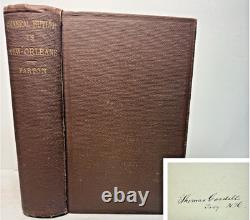
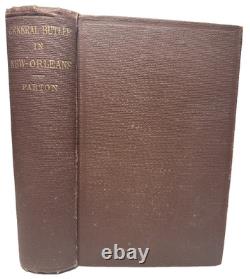
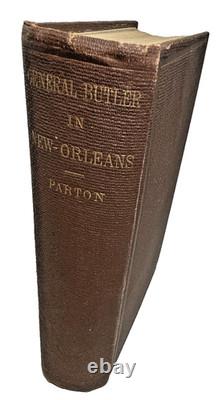

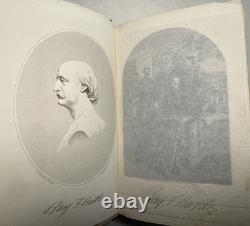
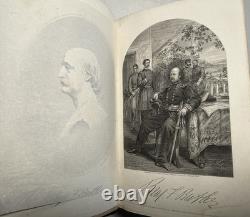
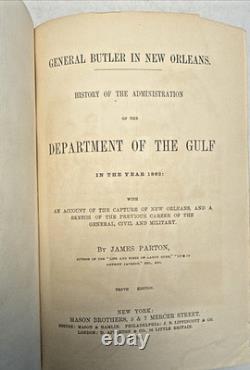


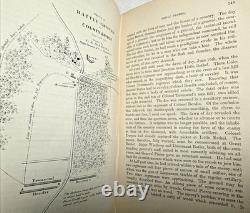
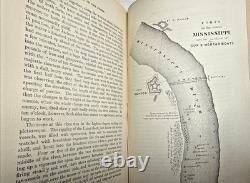



General Butler in New Orleans; history of the administration of the Department of the Gulf in the year 1862 with an account of the capture of New Orleans and a Sketch of the previous career of the general, civil and military. Is a contemporary account of Union General Benjamin Butler's administration in New Orleans during the American Civil War. Parton details Butler's military governance after the city's capture in 1862, highlighting both his controversial policies-such as the "Woman Order" and strict martial law-and his efforts to maintain order, support freed people, and enforce federal authority in a hostile environment. The book balances narrative description, political commentary, and moral evaluation, reflecting Northern perceptions of wartime leadership.
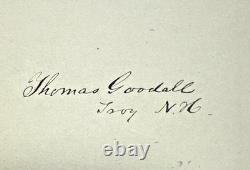
Serving as both historical record and interpretive biography, it provides insight into the complexities of military occupation, the challenges of civil-military relations, and the tensions of loyalty, law, and social change in occupied Confederate territory. Thomas Goodall, was a textile industrialist in Sanford. He was born in Dewsbury, Yorkshire, England, September 1, 1832. He was orphaned at age three, and apprenticed in woolen manufacturing at age eleven. He was placed in charge of the establishment at age seventeen and came to the United States in 1846.
After spending short periods in various places around New England, Mr. Goodall settled in Troy, New Hampshire where he first engaged in the manufacture of satinets and beavers. According to local historical accounts, one day Mr. Goodall observed a farmer struggling to secure a blanket on a horse, when he realized there was a market opening for horse blankets. He produced bales of them for the Union Army. Looking for new opportunities and settled in Sanford in October 1867. Goodall passed away in 1910, Sanford's population had risen dramatically and the mills were producing some of the finest textiles in the world. Measures 5.5 x 8.5 x 2. Condition: Please view the high resolution pictures for details.Covers are both firmly attached. Covers are clean with only light fading. Cover c orners, edges, and spine with some bumping. All pages are included and intact. No secondary writing or underlining.
Several pages have crease lines at the top (see pictured). Tissue paper is intact at title page.