
Union General George McClellan Standing CDV Civil War Antietam Mathew Brady
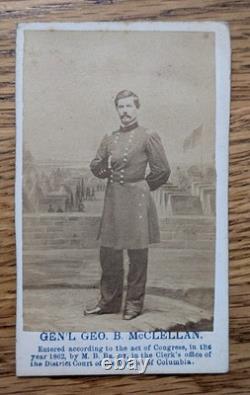

Original CDV with full standing view of McClellan in uniform posed al la Napoleon with one hand thrust in his coat and the other behind his back. The General is posed in front of a painted backdrop of a large walled in camp with a US flag waving proudly from the camp's flagpole. Image is clear and clean with good contrast. Bottom of mount is printed with GEN'L GEO. McCLELLAN and 1862 publishing information.
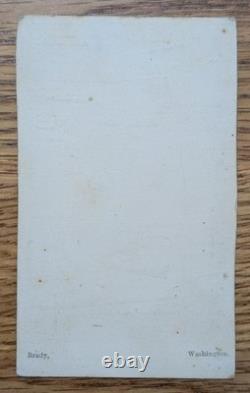
A few spots to image and verso. Reverse is blank except for the bottom corners that are marked "BRADY" and WASHINGTON.
" CDV measures 2 1/2" x 4 1/16. George Brinton McClellan was born December 3, 1826 in Philadelphia. He began his military career after entering the United States Military Academy in 1842. He graduated second in a class of fifty-nine in 1846. He was appointed as a brevet 2nd Lieutenant in the Corps of Engineers and served under General Winfield Scott during the Mexican War.
He was also a military observer during the Crimean War. In 1857, McClellan resigned from the Army to take a position with the Illinois Central Railroad. Upon the outbreak of the Civil War, Ohio governor William Dennison appointed McClellan Major General of Ohio Volunteers on April 23, 1861. This promotion, along with the support of Governor Denison, encouraged President Lincoln to commission McClellan a Major General in the Regular Army. McClellan secured Kentucky and western Virginia for the Union and this success, combined with the defeat of General Irvin McDowell at the battle of First Bull Run, led McClellan to become commander of the Army of the Potomac.
Later, upon the retirement of General Winfield Scott in November of 1861, McClellan became General-in-Chief of all Federal armies. After the defeat at Manassas, much of the Army of the Potomac was unorganized, and its new commander set to work providing the men proper military training and instilling in them a remarkable esprit de corps. In the spring of 1862, McClellan was removed as General-in-Chief, though he retained command of the Potomac Army. Facing great pressure from President Lincoln, he launched a campaign against the Confederate capital along the Virginia Peninsula, known as the Peninsula Campaign.
Continually misled by bad intelligence McClellan frequently delayed his attacks, allowing his opponent ample time to retreat slowly toward the Richmond defenses. After a tough fight at Fair Oaks Robert E.
Lee took command of the Confederate army facing McClellan. Taking advantage of McClellan's cautious streak, Lee hammered at the inert Army of the Potomac in a series of fierce and unrelenting assaults. With Little Mac at its head, the Army of the Potomac moved to counter Lee's 1862 invasion of Maryland. The two armies met at Antietam on September 17, 1862, the single bloodiest day of the war. Battle weary and bloodied, the Confederate Army retreated back into Virginia under the cover of darkness. In November of that year McClellan was relieved of command and ordered back to Trenton, New Jersey to await further orders, though none ever came. In 1864, McClellan was nominated to be the Democratic candidate for president. He ran on an anti-war platform, promising that he would negotiate peace terms with the Confederacy to help end the war as soon as possible. But by November of 1864, a string of Union successes had convinced many that the war was in its final phase.McClellan resigned his army commission on Election Day and lost the election. After the war, McClellan served as an administrator for a number of engineering firms and in 1878 was elected Governor of New Jersey. In his final years, the former general penned a defense of his tenure as commander of the Army of the Potomac, but died before he could see it published. He died on October 29, 1885 in Orange, New Jersey and is buried in Riverview Cemetery, Trenton, NJ.