
- Index
- Conflict
- Era
- Format
- Manufacturer
- Material
- Theme
- American Civil War (2)
- Americana (9)
- Antique (2)
- Army (3)
- Art (5)
- Celebrities (2)
- Civil War (13)
- Civil War General (2)
- Conflicts & Wars (7)
- Cosplay (2)
- History (14)
- Man, Portrait (2)
- Militaria (1298)
- Militaria, People (6)
- Militaria, Portrait (7)
- Military (2)
- Military & Adventure (17)
- Politics (8)
- Portrait (30)
- Portrait, Man (25)
- ... (3198)
General Theodore Peck Signed Check Civil War Medal of Honor Recipient
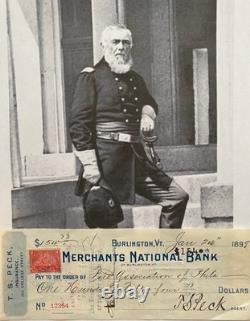
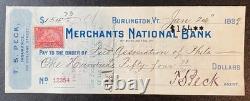
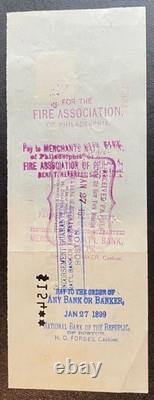
General Theodore Peck Signed Check - Civil War Medal of Honor Recipient. Offered for your consideration is a partly printed bank check, issued in 1899, signed by Civil War Medal of Honor recipient Captain (later General) Theodore Peck of the 9. The check is drawn on the "Merchants National Bank of Burlington" in Burlington, Vermont and is dated " January 24, 1899 ". The body of the check is made out to "Fire Association of Philadelphia" " One hundred and Fifty-four Dollars and 73/100 ", with the signature of " T S Peck " in his capacity as " agent " at the conclusion. One bank cancellation is noted on the front, and the reserve is stamped by the recipient.
Is also present on the left side of the check as. The United States enacted the War Revenue Act to fund the Spanish-American War. This check is interesting due to the rare signature of Captain Peck who. Received a medal of honor from Congress for gallantry in action at Newport Barracks, N. Captain (later General) Theodore S.
Adjutant-General Theodore Safford Peck was born in Burlington, Vermont, March 22, 1843. He enlisted at the age of eighteen as private in Company F, First Vermont Cavalry, September 1, 1861; mustered into the United States service November 1, 1861; transferred to Company K, and discharged for promotion June 25, 1862; appointed by Colonel George Jerrison Stannard, regimental quartermaster-sergeant Ninth Regiment Vermont Infantry, June 25, 1862; promoted second lieutenant Company C, January 7, 1863; promoted first lieutenant Company H, June 10, 1864; acting regimental quartermaster and adjutant, also acting assistant adjutant-general, aide-de-camp, and brigade quartermaster Second Brigade, Second Division, Eighteenth Army Corps; promoted captain and assistant quartermaster U. Volunteers March 11, 186, ; assigned to First Brigade, Third Division, Twenty-fourth Army Corps.
He served on the staffs of Brevet Major-General George J. Wistar at Suffolk, Virginia; Brigadier-General Joseph H.Potter, Brevet Brigadier General Michael T. Donahue, and Brevet Brigadier-General Edward H. Ripley, in the trenches in front of Petersburg and Richmond, Virginia. In the Vermont cavalry he was present in action at Middletown and Winchester, Va.
May 24 and 25, 1862; in the Ninth Regiment, Winchester, August, and Harper's Ferry, Va. 13, 14, and 15, 1862 (captured and paroled); siege of Suffolk, Nansemond, Edenton Road, Blackwater, May, 1863; Yorktown and raid to Gloucester Court-House, Va. 1863; action of Young's Cross-Roads, Dec. 2, 1864-, raid to Swansborough and Jacksonville, N. May, 1864; Fort Harrison Sept.29 and 30, 1864; Fair Oaks, Va. 29, 1864; eras present in New York City commanding a battalion, Ninth Vermont Regiment, in November, 1864, at the second election of President Lincoln. He was also present in the siege (winter, 1864 and spring, 1865) and capture of Richmond, Va. And was with the first organized command of infantry (Third Brigade, Third Division, Twenty-fourth Army Corps) to enter the rebel capital, at the surrender on the morning of April 3, 186-; his brigade was also provost-guard of the city for two weeks after its capture. He was wounded September 29, 1864, in the assault of Fort Harrison, Va.
He received a medal of honor from Congress for gallantry in action at Newport Barracks, NC, Feb. 2, 1864, on account of holding the enemy in check, and burning the county bridge in face of their fire of musketry and artillery from the opposite side of the Newport River, which is very narrow at this point. A part of his men was occupied in firing at the enemy, while with the rest he pulled up the planks and set the bridge on fire with dead grass which was pulled by hand from the ground. Lieutenant Peck had been notified that two companies of cavalry would report to him at this bridge with plenty of turpentine and tar to burn the same, but they failed to connect, and had not this bridge and one other been destroyed a serious disaster must have inevitably occurred to the Union troops, as they had been fighting a force ten times their number all day long, and these were their only avenues of retreat. Adjutant-General Peck was mustered out of the United States service, on account of the close of the war, June 23, 1865, having served nearly four years as a private in the ranks, an officer in the line and on the staff, a member of the cavalry corps, and also of the First, Fourth, Ninth, Eighteenth, and Twenty-fourth Army Corps, in the Armies of the Potomac and the James. The government at the close of the war offered him two commissions in the regular army, which were declined. Upon his return home to Vermont, he was appointed chief of staff, with rank of colonel, by Governor John W. Stewart; afterwards colonel of the first and only regiment of infantry of the National Guard of the State, which position he held for eight years. In 1869, assistant adjutant-general of the G. Department of Vermont; in 1872, senior vice-commander; and in 1876-77, department commander. In 1881 he was appointed adjutant-general, with rank of brigadier-general, and is on duty in this office at the present time. He is a charter member of the Vermont Commandery. Military Order of the Loyal Legion, and is a vice-president-general of the National Society, Sons of American Revolution. He had four ancestors in the Revolutionary War and one in the War of 1812.Peck was appointed by President Harrison a member of the Board of Visitors at the U. Is a resident of Burlington, Chittenden County, Vt.
This signed check measures approximately 3 1/8" x 8 ½" inches. A nice, representative example of a brave infantry officer, which would frame nicely, making a great addition to any Civil War or Medal of Honor collection.