
- Index
- Author
- A. L. Long (8)
- Asaad Alsaleh (7)
- Connie Rose Porter (3)
- Don C. Seitz (9)
- Doris Kearns Goodwin (4)
- Edward K. Gould (3)
- Elbridge Brooks (5)
- Gary Schreckengost (2)
- George Meade (2)
- Jeff Shaara (3)
- John D. Long (3)
- John Esten Cooke (7)
- John Russell Young (3)
- Odie Faulk (2)
- Oliver Otis Howard (4)
- Sherman (2)
- State Of Virginia (2)
- Ulysses S. Grant (4)
- Unknown (6)
- Various (3)
- ... (4586)
- Binding
- Subject
- Americana (18)
- Andrew Jackson (4)
- Civil War (47)
- Civil War, Men (6)
- Collectible (10)
- Family (3)
- Figures & Portraits (11)
- Historic & Vintage (3)
- History (69)
- Law & Government (3)
- Literature & Fiction (7)
- Men (9)
- Men, Civil War (102)
- Men, Military (35)
- Military (72)
- Military & Political (106)
- Military & War (211)
- Military, Political (7)
- Portrait (8)
- Presidents (5)
- ... (3932)
- Theme
- American Civil War (2)
- Americana (9)
- Antique (2)
- Army (3)
- Art (5)
- Celebrities (2)
- Civil War (13)
- Civil War General (2)
- Conflicts & Wars (7)
- Cosplay (2)
- History (14)
- Man, Portrait (2)
- Militaria (1303)
- Militaria, People (6)
- Militaria, Portrait (7)
- Military (2)
- Military & Adventure (17)
- Politics (8)
- Portrait (30)
- Portrait, Man (25)
- ... (3207)
- Topic
- Year Printed
C. 1860's General Joseph Hooker Carte de Visite Photo by Matthew Brady
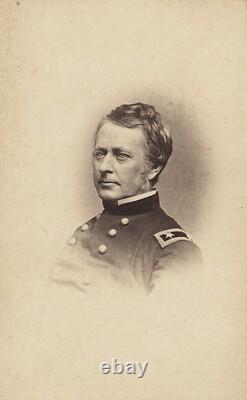
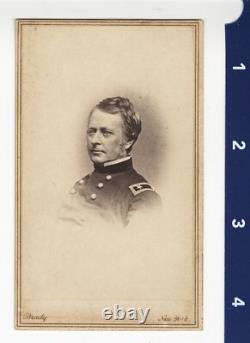
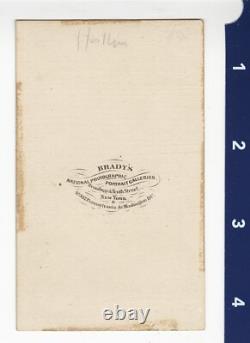


PHOTOGRAPHER : Matthew Brady (see bio below). SUBJECT : General Joseph Hooker (see bio below). SIZE : Board measures 2.5" x 4", and mounted photo measures 2.25" x 3.5". Matthew Brady was born in 1822 in Warren County, New York.
Little is known about his early life, but he moved to Saratoga Springs as a young man and later to New York City in the 1840s, where he studied photography and portrait making under the guidance of Samuel F. Morse, who had learned the daguerreotype process in France. Brady quickly established himself as a skilled photographer and opened his own studio in New York in 1844.
By 1849, he had expanded his operations to Washington, D. Where he became a prominent portraitist of political and cultural figures. Throughout the 1850s, Brady photographed many of the most famous Americans of his day, including writers, military leaders, scientists, and more than a dozen future U. His goal was to preserve a photographic "Gallery of Illustrious Americans, " capturing the likenesses of prominent individuals for posterity. He gained national recognition for both the quality of his daguerreotypes and the ambition of his archival mission. When the Civil War began in 1861, Brady saw an opportunity to document the conflict in a way no war had ever been captured before. Despite the personal and financial risk, he organized and financed a team of photographers to cover the war on both Union and Confederate fronts. Among the photographers working under Brady's name were Alexander Gardner, Timothy O'Sullivan, and George Barnard. They used bulky cameras, glass plate negatives, and horse-drawn darkrooms to capture haunting images of battlefields, encampments, fortifications, and the aftermath of combat. In 1862, Brady exhibited photographs from the Battle of Antietam in his New York gallery under the title The Dead of Antietam.The stark images shocked the public, many of whom had never before seen such realistic depictions of death and war. These photos helped change the way Americans perceived the Civil War and the nature of modern warfare itself. Though Brady's name became associated with the photographic record of the war, he did not always receive credit for the work of his operators, many of whom eventually left to establish their own studios. After the war, Brady hoped the U.
As a result, he suffered financially and eventually declared bankruptcy. Brady continued to work in photography after the war, but his prominence declined in the face of changing technology and public tastes. In his later years, he lived in relative obscurity and financial hardship. He died on January 15, 1896, in New York City, following an accident and a prolonged period of poor health. Matthew Brady is remembered today as one of the most important photographers in American history. His pioneering efforts in portrait photography and his ambitious documentation of the Civil War created an enduring visual record that continues to shape how the conflict is remembered. His work laid the foundation for photojournalism and demonstrated the power of photography to inform, influence, and move the public. Joseph Hooker was born on November 13, 1814, in Hadley, Massachusetts.He graduated from the United States Military Academy at West Point in 1837, ranking near the middle of his class. Early in his military career, he served in the Seminole Wars and then played an active role during the Mexican-American War, where he distinguished himself in several battles and earned promotions for gallantry. After the war, he remained in the army for a time but eventually resigned in 1853 and worked in various civil and agricultural roles in California.
He was appointed brigadier general of volunteers and quickly rose through the ranks due to his energy and aggressive leadership. He earned the nickname "Fighting Joe" after a newspaper misprint shortened a report headline about him. He commanded divisions and corps in several key battles, including the Peninsula Campaign and the Battle of Antietam, where his performance brought him increased responsibility. In early 1863, after the disastrous Union defeat at Fredericksburg, President Abraham Lincoln appointed Hooker as commander of the Army of the Potomac. As commander, he improved the army's organization, logistics, and morale.
However, his leadership was tested in May 1863 at the Battle of Chancellorsville. Despite having a larger and better-supplied force, he was decisively defeated by Confederate General Robert E. The loss led to his resignation from command of the army, which was accepted in June 1863.After leaving command of the Army of the Potomac, Hooker was transferred to the Western Theater. He played a significant role in the Battle of Lookout Mountain during the Chattanooga Campaign and later participated in the Atlanta Campaign under General William T. His relationship with Sherman deteriorated, and when he was passed over for promotion following the death of General James McPherson, he requested to be relieved from duty in 1864. Hooker spent the final years of the war in administrative positions and did not return to major field command.
He retired from the army in 1868 with the rank of major general. He spent his final years in New York and Garden City, Long Island, where his health gradually declined after suffering a stroke.
Joseph Hooker died on October 31, 1879, at the age of 64. He was buried in Cincinnati, Ohio. Though his military career was marked by both notable successes and serious setbacks, he was a capable and determined leader whose contributions helped shape the Union war effort during a critical period of the American Civil War.