
- Index
- Conflict
- Era
- Format
- Industry
- Signed
- Theme
- American Civil War (2)
- Americana (9)
- Antique (2)
- Army (3)
- Art (5)
- Celebrities (2)
- Civil War (13)
- Civil War General (2)
- Conflicts & Wars (7)
- Cosplay (2)
- History (14)
- Man, Portrait (2)
- Militaria (1299)
- Militaria, People (6)
- Militaria, Portrait (7)
- Military (2)
- Military & Adventure (17)
- Politics (8)
- Portrait (30)
- Portrait, Man (25)
- ... (3201)
Confederate Postmaster General John H. Reagan & other Signatures/ Civil War
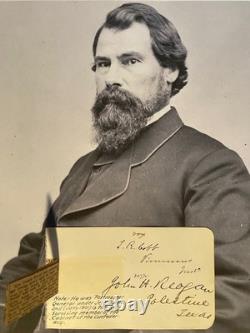
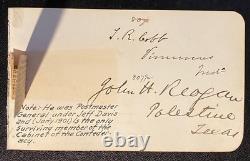
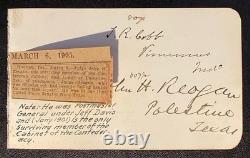
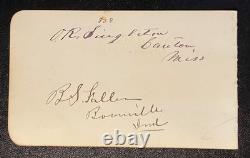


Confederate Postmaster General John H. Reagan & Others Signature/ Civil War. Reagan on one side with his obituary and a signature of US Senator & Congressman Thomas R. On the other side of the page are signatures of Confederate Congress Otho R.
Singleton (MS) and US Senator & Congressman Benoni S. The autograph page measures approximately 5 1/8" x 3 1/8". This is a rare opportunity given the page has signatures from a member of Confederate President Jefferson Davis's cabinet, a Confederate congressman, and two Union Civil War Senators from Indiana.
Not only do you get a chance to own a piece of history, but you get four autographs from key Civil War leaders on one piece of paper which makes it a must have for any Confederate or Civil War collection. Postmaster General John Henninger Reagan. The highest-ranking Texan in the Confederate government, John Henninger Reagan, proved to be a crucial figure in nineteenth century politics. A leading Texas Democrat, he served not only as Postmaster General of the Confederacy, but also as a United States Congressman both before and after the Civil War.
Born in Sevier County, Tennessee, in 1818, Reagan studied briefly at Southwestern Seminary in Maryville before moving to Natchez, Mississippi, to manage a plantation. This experience provided few opportunities for advancement, however, and Reagan moved to Nacogdoches, Texas, in 1839 in hopes of finding more rewarding work. Shortly after his arrival, he took up arms in the Cherokee War and fought to rid the local area of hostile Indians. Reagan then worked as a surveyor, scout, and justice of the peace. While serving in these various positions, he also found time to study law and eventually set up his own practice in the small hamlet of Buffalo, Texas, in 1846.
Reagan's success in the legal field opened opportunities in the world of politics, and he won election to the Second Legislature of Texas in 1847. Reagan was not out of public service for long, though. In 1852, he won election to serve as judge of the Ninth Judicial District of Texas, and his popular stance against the Know-Nothing party helped him win re-election in 1856. The following year, Reagan ran for and won a seat in the United States Congress.
His 1857 election placed him in Washington during a crucial period, as the nation struggled to deal with the debate over slavery. Reagan pursued a pro-Unionist position until John Brown's raid on the federal arsenal at Harper's Ferry, Virginia, in October 1859.
With secession fever sweeping Texas, Reagan resigned his seat in the U. Congress on January 15, 1861 and took part in his state's secession convention fifteen days later. Although he could not convince then-governor Sam Houston to support secession, Reagan did ultimately vote with the majority of his colleagues to secede from the Union. Shortly thereafter, Reagan was sent as a state representative to the Confederate capital of Montgomery, Alabama, where he was asked by the new Confederate president, Jefferson Davis, to serve in his cabinet as postmaster general. Reagan accepted and served in this position throughout the war, doing his best to make sure the Confederate postal system functioned until the fall of Richmond in 1865.
When Richmond was evacuated, Reagan fled with the rest of the Confederate cabinet and was captured along with Jefferson Davis in rural Georgia. After the war, Reagan spent six months in federal prison before he was released and allowed to return to Texas.Upon his return, he found his home state in turmoil. Republicans controlled the governorship and legislature, and the strain of Reconstruction was being felt by most people in the state. Reagan fought the Republicans tooth and nail, and he served a key role in the removal of Republican governor Edmund Davis in 1875.
In fact, that year proved to be a crucial one for Reagan, as he was also elected to his former congressional seat and participated in the drafting of the new Texas constitution. Based on his record in the U. House of Representatives, Reagan won election to the United States Senate in 1887, but he resigned his post after four years to serve as chairman of the Railroad Commission of Texas, a position he held until 1903. He also helped to establish the Texas State Historical Association in Austin in 1897. Reagan died at his home in Palestine on March 6, 1905. Confederate Congressman Otho Robards Singleton Biography. Born on October 14, 1814, near Nicholasville, Kentucky, graduated from St. Joseph College in Kentucky and then received a law degree from the University of Lexington. He moved to Mississippi and became a practicing attorney in 1838. Shortly after establishing his law practice, Singleton became involved in state politics. He won election to the Mississippi House of Representatives in 1846 and then won a seat in the Mississippi Senate in 1848, serving until 1854. Singleton's political career continued to rise, and in 1854 he won election to the U. While he lost reelection after his first term, he regained a congressional seat in 1857 and served in the U. Congress until Mississippi declared its secession from the Union in January 1861, following Abraham Lincoln's election to the presidency. He immediately ran for, and won, a seat in the Confederate Congress, serving through the Civil War. After the Civil War, Singleton did not hold notable public office until near the end of Reconstruction, winning a seat to the U. House of Representatives from Mississippi in 1875.He won reelection several times, serving until 1887. Singleton died two years later, on January 11, 1889.
He is buried in Canton City Cemetery in Canton, Mississippi. Indiana Senator & Congressman Thomas Reed Cobb Biography. A Representative from Indiana; born in Springville, Lawrence County, Ind.July 2, 1828; attended Indiana University, Bloomington, Ind. Studied law; was admitted to the bar in 1851 and commenced practice in Bedford, Ind. Commissioned major of Indiana Militia in 1852; moved to Vincennes, Ind. June 23, 1892; interment in Old Vincennes Cemetery.
A Representative from Indiana; born near Boonville, Warrick County, Ind. April 14, 1903; interment in Old Boonville Cemetery.