
- Index
- Author
- A. L. Long (8)
- Asaad Alsaleh (7)
- Connie Rose Porter (3)
- Don C. Seitz (9)
- Doris Kearns Goodwin (4)
- Edward K. Gould (3)
- Elbridge Brooks (5)
- Gary Schreckengost (2)
- George Meade (2)
- Jeff Shaara (3)
- John D. Long (3)
- John Esten Cooke (7)
- John Russell Young (3)
- Odie Faulk (2)
- Oliver Otis Howard (4)
- Sherman (2)
- State Of Virginia (2)
- Ulysses S. Grant (4)
- Unknown (6)
- Various (3)
- ... (4582)
- Binding
- Conflict
- Subject
- Americana (18)
- Andrew Jackson (4)
- Civil War (47)
- Civil War, Men (6)
- Collectible (10)
- Family (3)
- Figures & Portraits (11)
- Historic & Vintage (3)
- History (69)
- Law & Government (3)
- Literature & Fiction (7)
- Men (9)
- Men, Civil War (102)
- Men, Military (35)
- Military (72)
- Military & Political (106)
- Military & War (210)
- Military, Political (7)
- Portrait (8)
- Presidents (5)
- ... (3929)
- Topic
- Year Printed
Civil War Quartermaster General Montgomery Meigs Signed 1865 Cover
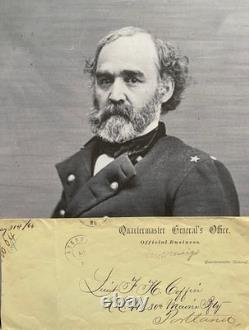
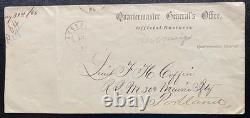

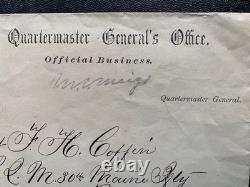


Civil War Quartermaster General Montgomery Meigs Signed 1865 Cover. Maine Infantry Regiment in Portland, Maine. Handstamp frank: reduced at left dated August 13, 1865 (one week for the regiment was mustered out) Augusta, ME (Maine) postmarks. Meigs was writing to Lt.
Francis Hale Coffin, the quartermaster of the 30. Maine Infantry who was in Maine being mustered out of the army as the war had ended.
Was involved in several campaigns and battles during the Civil War, including the Red River Campaign in Louisiana and operations in the Shenandoah Valley. Three very interesting historical facts about Quartermaster General Meigs; one is that he established Arlington National Cemetery following a tumultuous four years as the country was embroiled in civil war. During the Civil War, Meigs served as the Quartermaster General for the Union Army. He saw to the outfitting of Union troops with food, supplies and ammunition, organized campaigns, and helped track the course of the war. As caravans of Union casualties continued to fill the streets and cemeteries of Washington, the government was in desperate need of land in which to inter these fallen soldiers.
In 1864 the Office of the Quartermaster General was tasked with identifying the site of a new government cemetery. Meigs knew just the place-Arlington, which had been the home and estate of Confederate General Robert E. Meigs was also the architect of building the Capitol Dome and the. Union Arch Bridge across Cabin John Creek (the world's largest single-span masonry arch for more than 40 years).John Rodgers Meigs, of Major Gen. Sheridan's staff, was killed during an encounter with the Black Horse Cavalry in 1864 the Union army struck back. In retaliation for the death of Lt. Meigs, twenty-one houses were burned. In Rockingham County alone, three hundred barns filled with grain were burned, and at least five hundred African Americans were driven off.
From mountain to mountain, in this once loveliest of Virginia's valleys, desolation reigns, the blackness of conflagration has taken the place of happy homesteads, and the ground is crisped and withered on the playground of the now homeless little ones. He hired a private detective whose investigation continued after the end of the war. Montgomery Meigs originally had his son buried in the Oak Hill Cemetery in Washington, DC, but later moved him to Arlington Cemetery which he had helped institute. His monument in Arlington is an exact replication of the way his body was found as it was lying in the road.
This is a rare opportunity to own a piece of history signed the Quartermaster General and a high-ranking member of the United States leadership which makes it must have for any Civil War collection. Appointed Quartermaster General in May 1861, during the Civil War, General Meigs was an efficient, hard-driving and scrupulously honest.
He molded a large and somewhat diffuse department into a great tool of war. He was one of the first to fully appreciate the importance of logistical preparations in modern military planning. Under his capable leadership supplies moved forward and troops were transported over long distances with ever greater efficiency.Meigs, soldier, engineer, was born in Augusta, GA. During his childhood the family moved from Georgia to Philadelphia, where he entered the University of Pennsylvania in 1831. He left that university in 1832 to enter the United States Military Academy, graduating fifth in his class in 1836.
After temporary assignments to the Artillery, he was transferred to the Engineer Corps spending a quarter of a century, devoting his conspicuous ability to many important engineering projects. Of these, his favorite was the Washington Aqueduct. This work, of which he was in charge from 1852 to1860, also involved the design of the monumental bridge across Cabin John Branch which for some fifty years remained unsurpassed as the longest masonry arch in the world. From 1853 to 1859 he also supervised the building of the wings and dome of the national Capitol, and from 1855 to 1859, the extension of the General Post Office Building, as well as the direction of many minor works of construction. In the fall of 1860.As a result of a disagreement over certain contracts, Meigs incurred the ill will of the Secretary of War, John B. Floyd, and was "banished to Tortugas in the Gulf of Mexico to construct fortifications at that place and at Key West". Upon the resignation of Floyd a few months later, he was recalled to his work on the aqueduct at Washington. In the critical days preceding the outbreak of the Civil War, Meigs and Lieutenant Colonel E. Keyes were quietly charged by President Lincoln and Secretary Seward with drawing up a plan for the relief of Fort Pickens, Florida.
By means of a secret expedition. In April, 1861, together with Lieutenant.
Porter of the Navy, they carried out the expedition, embarking under orders from the President without the knowledge of either the Secretary of the Navy or the Secretary of War. On May 14, 1861, Meigs was appointed colonel, 11th Infantry, and on the following day, promoted to brigadier general and Quartermaster General of the Army. Of his work in this office James G. Meigs, one of the ablest graduates of the Military Academy, was kept from the command of troops by the inestimably important services he performed as Quartermaster General.
The aggregate sum could not have been less during the war than fifteen hundred million dollars, accurately vouched and accounted for to the last cent. Secretary of State William H. Seward's estimate was that without the services of this eminent soldier the national cause must have been lost or deeply imperiled. His brilliant services during the Civil War included command of Grant's base of supplies at Fredericksburg and Belle Plain (1864), command of a division of War Department employees in the defenses of Washington at the time of Early's raid (July 11-14, 1864), personally supervising the refitting and supplying of Sherman's Army at Savannah (Jan 5-29 1865), and at Goldsboro and Raleigh, N.
Reopening Sherman's lines of supply (March-April 1865). He was brevetted Brigadier General on July 5, 1864. General Meigs recommended that property in Arlington, Virginia owned by Mary Custis Lee, the wife of Robert E. Lee, be used as a military burial ground. Based on this recommendation, Arlington National Cemetery was created in 1864.
In October of that same year, his son, First Lieutenant John Rodgers Meigs was killed at Swift Run Gap in Virginia. He is buried at Arlington Cemetery.
As Quartermaster General after the Civil War, Meigs supervised plans for the new War Department building (1866-67), the National Museum (1876), the extension of the Washington Aqueduct (1876) and for a hall of records (1878). In 1866-68, to recuperate from the strain of his war service, he visited Europe, and in 1875-76 made another visit to study the government of European armies. After his retirement on February 6, 1882, he became architect of the Pension Office Building. He was a regent of the Smithsonian Institution, a member of the American Philosophical Society, and one of the earliest members of the National Academy of Sciences. Meigs died in Washington on January 2, 1892, after a short illness and his body was interred with high military honors in Arlington National Cemetery.
4,1892 issued at the time of his death declared that the Army has rarely possessed an officer. Who was entrusted by the government with a great variety of weighty responsibilities, or who proved himself more worthy of confidence. General Meigs was inducted into the Quartermaster Hall of Fame in 1986 (Charter Year).
The American Continental Congress adopted the practice in 1775, and the First Congress wrote it into law in 1789. In addition to senators and representatives, the president, cabinet secretaries, and certain executive branch officials also were granted the frank. Until the 1860s, members of Congress spent a great deal of time carefully inscribing their names on the upper right-hand corner of official letters and packages.
One member boasted that if the envelopes were properly arranged, he could sign as many as 300 per hour. After the Civil War, senators and representatives reduced the tedium of this chore by having their signatures reproduced on rubber stamps. Intended to improve the flow of information across a vast nation, the franking privilege lent itself to abuse and controversy.Stories circulated of members who routinely franked their laundry home and who gave their signatures to family and friends for personal use. Legend had it that one early nineteenth-century senator even attached a frank to his horse's bridle and sent the animal back to Pittsburgh. Responding to charges of governmental extravagance, the 1872 Republican Party platform carried a plank that demanded the frank's elimination. On January 31, 1873, the Senate voted to abolish the congressional franking privilege after rejecting a House-passed provision that would have provided special stamps for the free mailing of printed Senate and House documents. Within two years, however, Congress began to make exceptions to this ban, including free mailing of the Congressional Record, seeds, and agricultural reports.