
- Index
- Author
- A. L. Long (8)
- Asaad Alsaleh (7)
- Connie Rose Porter (3)
- Don C. Seitz (9)
- Doris Kearns Goodwin (4)
- Edward K. Gould (3)
- Elbridge Brooks (5)
- Gary Schreckengost (2)
- George Meade (2)
- Jeff Shaara (3)
- John D. Long (3)
- John Esten Cooke (7)
- John Russell Young (3)
- Odie Faulk (2)
- Oliver Otis Howard (4)
- Sherman (2)
- State Of Virginia (2)
- Ulysses S. Grant (4)
- Unknown (6)
- Various (3)
- ... (4584)
- Binding
- Conflict
- Industry
- Signed
- Theme
- American Civil War (2)
- Americana (9)
- Antique (2)
- Army (3)
- Art (5)
- Celebrities (2)
- Civil War (13)
- Civil War General (2)
- Conflicts & Wars (7)
- Cosplay (2)
- History (14)
- Man, Portrait (2)
- Militaria (1302)
- Militaria, People (6)
- Militaria, Portrait (7)
- Military (2)
- Military & Adventure (17)
- Politics (8)
- Portrait (30)
- Portrait, Man (25)
- ... (3206)
Civil War Pension Fraud 1874 NY General Store Ledger Political Memoir Manuscript
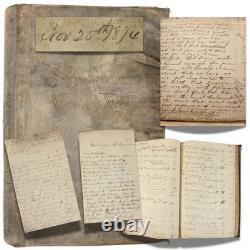
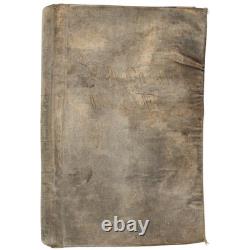
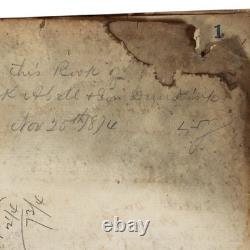
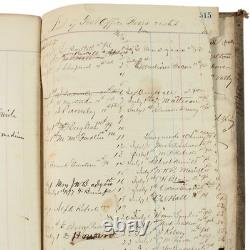
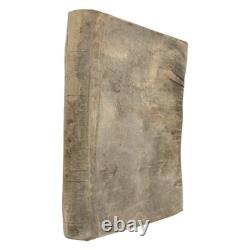
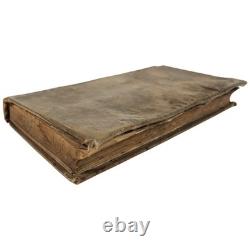
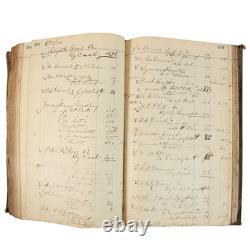
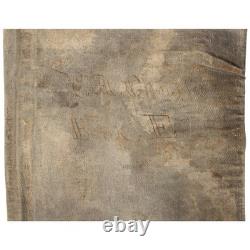
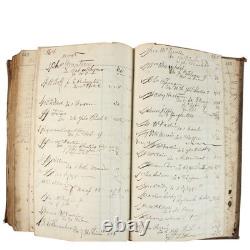
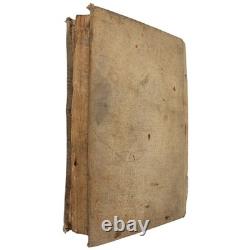

CHAFFE'S DAYTON LEDGER: General Store Day-Book of N. Chaffe, Dayton Station, Cattaraugus County, New York, with Manuscript Political Memoir, Civil War Pension Letters, and Evidence of Pension Fraud by Political Coercion. Good manuscript ledger in original cloth-backed boards, worn at extremities with heavy water damage to front board, spine intact, binding sound.
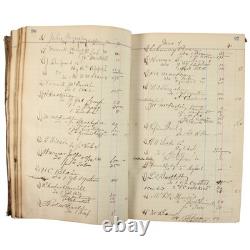
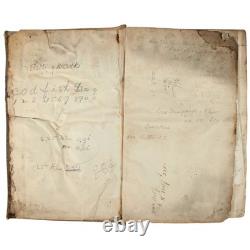
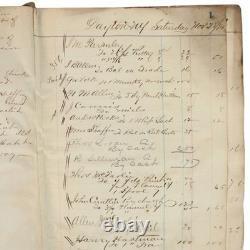
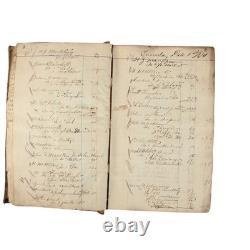
Folio, approximately 577+ numbered pages of manuscript entries in ink on ruled paper, with additional manuscript text on front and rear flyleaves, and two laid-in manuscript letters (one sheet each, both written recto and verso). This ledger is five things at once, and each stands on its own as primary documentation of Reconstruction-era rural New York. From Saturday, November 28, 1874 onward, N. Chaffe kept a meticulous daily record of his general store trade at Dayton Station, Cattaraugus County - a hamlet that was, at the precise moment this ledger opens, being transformed by the arrival of the Buffalo and Southwestern Railroad, the first line through Dayton having opened between October 1874 and July 1875.
The cast of customers - Markham, McFarlin, Burns, Blaisdell, Thrasher, Moulton, Parmley, Hartman, Johnson, Blair, Bartlett, Knoulton, and dozens more - are precisely the surnames documented in Dayton town histories and the 1875 Cattaraugus County census. This is the commercial record of a community, not merely a shopkeeper's accounts. At least 88 boxes are recorded across two sections, the list divided by the notation "Howards" - confirming that Chaffe was operating postal services for both Dayton Station and the Howard's Corners hamlet, the precise geographic split that underlies the political conflicts recorded later in the same volume. Among the box holders are Mrs. Badger (box 15) - wife of the J.
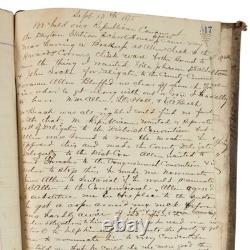
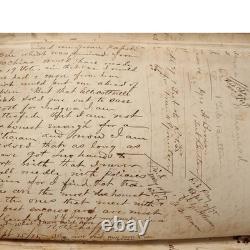
Badger named in the pension coercion allegation - and entries corresponding to Norman Allen and Cornelius Allen, the political antagonists of the memoir. That the store served as a rural sub-post office was standard practice in this era; that the box register survives intact within the same volume as the pension and political documents transforms it from administrative record into social map. At the end of the ledger dated September 13, 1875, the ledger pivots without warning from postal accounts into a private political reckoning Chaffe clearly never intended for other eyes.
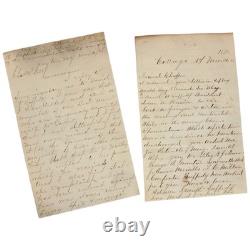
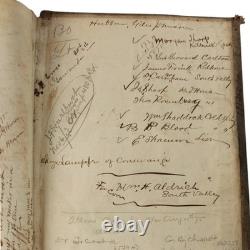
He describes the Republican caucus at the Dayton Station Schoolhouse, a near-violent factional split between the Allen clique at Howard's Corners and his own group, and a series of deals in which he was methodically used and discarded by Norman Allen. Allen maneuvered Chaffe into nominating him for Senatorial and Congressional conventions while delivering nothing in return - substituting Chaffe into his own place at one convention without warning, so that Chaffe got a rope around my neck before I was hardly aware of it. " The account continues through September 25th, when Chaffe records that Allen "never paid any more to me. This is Grant-era Republican machine politics at the granular village level - the same machinery corroding national Reconstruction - recorded from the inside by a man who lost, in a grocery ledger, in ink, with no expectation of an audience. The verso of the front flyleaf contains Chaffe's notes on an official inquiry from the U. Department of the Interior Pension Office, dated March 4, 1876, concerning the rheumatism claim of Civil War veteran Daniel W. The notes record the testimony of H. Jacket, confirming Lafferty's condition is genuine and service-contracted - and then the bombshell: that Charles Blair told Lafferty directly that if he did not vote for J. Badger for Justice of the Peace, his pension would be taken away. This is not rumor; it is a written record of witness testimony to a specific act of political coercion against a disabled Union veteran. Badger, wife of the candidate in whose interest the threat was made, rented Post Office box 15 at Chaffe's store. Two manuscript letters accompany the ledger, each a single sheet written on both sides.The first, dated Dayton, NY, March 13, 1876, is a copy in Chaffe's hand of his letter to Commissioner Chas. Gill of the Department of the Interior, defending Lafferty: "it is the opinion of the majority of those who know him best that he is worthy of his pension, " adding that the complaint was mounted through every spite and revenge.
" The second, dated Cottage, NY, March 10, 1876, addressed to "Friend Chaffe, " confirms Lafferty "drew a pension, he has lost a finger and a toe in the army and contracted while in the army chronic rheumatism, and refers Chaffe to a roster of reliable witnesses - Giles A. Grantier, Squire Hubbard, Johnson Merritts, J. The convergence here is what makes this ledger exceptional. A rural Western New York general store day-book is a modest collectible on its own terms. But this one also contains a private manuscript account of Gilded Age Republican machine politics at the township level, documentary evidence of Civil War pension coercion for a local political vote, the original correspondence in a federal pension inquiry, and a post office box register that ties the store's daily customers directly to the political and legal dramas unfolding in the same volume's margins. These threads don't merely coexist - they name the same people: the Allens are in the store ledger, the post office register, and the political memoir; the Badgers are in the pension coercion allegation and the PO box list; Chaffe himself is storekeeper, postmaster, political operative, pension advocate, and ultimately disgusted witness to it all. The Cattaraugus County Historical Museum in Machias, the Dayton Historical Society, and special collections programs in Civil War veteran affairs and Gilded Age rural history would recognize this immediately. So should any serious collector of American manuscript Americana.Civil War Pension Fraud 1874 NY General Store Ledger Political Memoir Manuscript.