
- Index
- Author
- A. L. Long (8)
- Asaad Alsaleh (7)
- Connie Rose Porter (3)
- Don C. Seitz (9)
- Doris Kearns Goodwin (4)
- Edward K. Gould (3)
- Elbridge Brooks (5)
- Gary Schreckengost (2)
- George Meade (2)
- Jeff Shaara (3)
- John D. Long (3)
- John Esten Cooke (7)
- John Russell Young (3)
- Odie Faulk (2)
- Oliver Otis Howard (4)
- Sherman (2)
- State Of Virginia (2)
- Ulysses S. Grant (4)
- Unknown (6)
- Various (3)
- ... (4582)
- Binding
- Conflict
- Subject
- Americana (18)
- Andrew Jackson (4)
- Civil War (47)
- Civil War, Men (6)
- Collectible (10)
- Family (3)
- Figures & Portraits (11)
- Historic & Vintage (3)
- History (69)
- Law & Government (3)
- Literature & Fiction (7)
- Men (9)
- Men, Civil War (102)
- Men, Military (35)
- Military (72)
- Military & Political (106)
- Military & War (210)
- Military, Political (7)
- Portrait (8)
- Presidents (5)
- ... (3929)
- Topic
- Year Printed
CIVIL War Iowa General Samuel R Curtis Command Order 1864
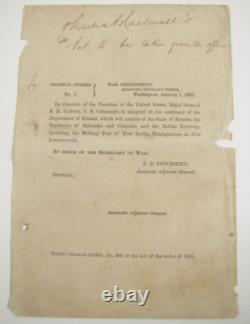
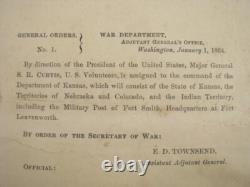

Iowa Major General Samuel R Curtis, a notable Frontier US Army officer and Keokuk, Iowa Pioneer, raised the 2nd Iowa Infantry in 1861, commanded the Union Forces in Missouri incl the Battle of Pea Ridge Arkansas, and in 1864 took command of the US frontier forces. He is widely considered to be the most effective Frontier officer of the Civil War. An Original Civil War General Order issued by the War Department at Washington, January 1, 1984 assigning General Samuel R Curtis to command of the Department of Kansas including Nebraska and Colorado Territory and the Indian Territory. The 1p 8 x 5 ptd.
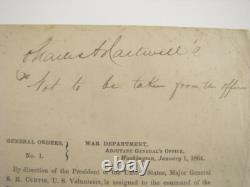
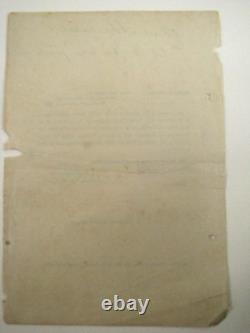
Order has 2 punch holes in the left margin for red tape loose binding by an officer. Printed on thin, rag paper with edge wear, tears, archival repair on reverse, age stains, Overall Good Condition. The General Order has an ink inscription at the top "Charles Hartwell's ", a small outline of a pointing finger, and "Not to be taken from the office".
Comes w service and bio info. Charles A Hartwell had served as an officer with the11th US Infantry when he was wounded and taken prisoner at the Battle of Gaines Mill, Virginia in 1862 and exchanged for a Tennessee Confederate officer, and by 1864 was Colonel of the 77th USCT.
Hartwell finished the War as a brevet brigadier general. I got this Order from the estate of Lt George Faxon, also a USCT officer who served with Hartwell in Louisiana at this time. General & Special Orders were issued to communicate commands and information to the Army. Each order, issued in writing by a command, was then printed for distribution to each unit, either at an army department headquarter or by commanders at local headquarters in the field on portable printing presses operated by soldiers.
The orders were then issued to regiments, to be read aloud to the troops. General Orders were printed as issued with date & location; at the end of a year the regimental adjutant might retain them loose or simply string bind them by punching holes or cut slits in the left margin and stringing on ¼" red cloth string tape (the source of the old expression "government red tape). Sometimes an officer or HQ clerk might take a group of orders to a local print shop or bookbinder and have an accumulation bound with leather or cloth covers. Usually, American Military Orders of the 19. Century including Civil War era were printed on an 8 x 5 sheet of quality rag paper.
General Orders and other imprints. All items are unconditionally guaranteed to be authentic and in the condition as described. PLEASE READ DETAILS OF THE ITEM DESCRIPTION. I TRY TO DESCRIBE ALL ITEMS ACCURATELY.