
- Index
- Author
- A. L. Long (8)
- Asaad Alsaleh (7)
- Connie Rose Porter (3)
- Don C. Seitz (9)
- Doris Kearns Goodwin (4)
- Edward K. Gould (3)
- Elbridge Brooks (5)
- Gary Schreckengost (2)
- George Meade (2)
- Jeff Shaara (3)
- John D. Long (3)
- John Esten Cooke (7)
- John Russell Young (3)
- Odie Faulk (2)
- Oliver Otis Howard (4)
- Sherman (2)
- State Of Virginia (2)
- Ulysses S. Grant (4)
- Unknown (6)
- Various (3)
- ... (4586)
- Binding
- Subject
- Americana (18)
- Andrew Jackson (4)
- Civil War (47)
- Civil War, Men (6)
- Collectible (10)
- Family (3)
- Figures & Portraits (11)
- Historic & Vintage (3)
- History (69)
- Law & Government (3)
- Literature & Fiction (7)
- Men (9)
- Men, Civil War (102)
- Men, Military (35)
- Military (72)
- Military & Political (106)
- Military & War (211)
- Military, Political (7)
- Portrait (8)
- Presidents (5)
- ... (3932)
- Theme
- American Civil War (2)
- Americana (9)
- Antique (2)
- Army (3)
- Art (5)
- Celebrities (2)
- Civil War (13)
- Civil War General (2)
- Conflicts & Wars (7)
- Cosplay (2)
- History (14)
- Man, Portrait (2)
- Militaria (1303)
- Militaria, People (6)
- Militaria, Portrait (7)
- Military (2)
- Military & Adventure (17)
- Politics (8)
- Portrait (30)
- Portrait, Man (25)
- ... (3207)
- Topic
- Year Printed
1861 Independence of the South by General Roger A. Pryor/ Confederate Imprint
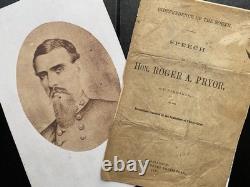
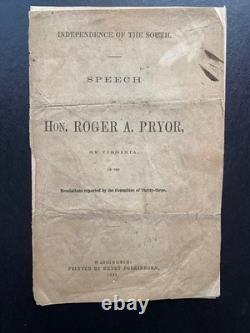
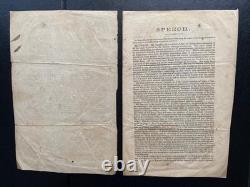
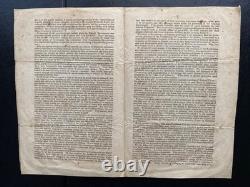
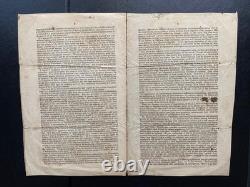
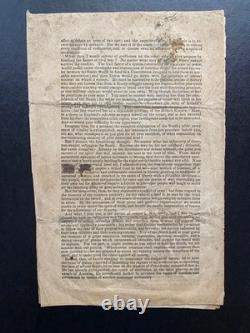

1861 Independence of the South Speech by General Roger A. (General) Roger Pryor of Virginia's speech on the Resolutions reported by the Committee of Thirty-three. Printed in Washington, by Henry Polkinhorn. In poor condition with (8) eight pages separated from spine but extremely rare and readable for a 164-year-old document. Pryor, a Virginia congressman and fervent secessionist, gave this speech entitled "Independence of the South" in response to the resolutions presented by the House Committee of Thirty-three in 1861.
Committee of Thirty-three: Formed in December 1860, this House committee aimed to find solutions and avoid the impending Civil War by addressing the secession crisis, particularly focusing on the expansion of slavery. Failed compromises: The Committee's efforts, including the proposed Corwin Amendment which aimed to safeguard slavery in existing states, ultimately failed to prevent the South's secession or the outbreak of war. Pryor's speech advocated for secession and condemned compromise with the North, reflecting his strong pro-slavery views and belief in states' rights. He criticized the Committee's proposals for not adequately addressing Southern concerns or for attempting to restrict the institution of slavery. Pryor's speech and the Committee of Thirty-three's failure to find a compromise underscores the deeply rooted divisions over slavery that ultimately led to the Civil War. His speech provides a glimpse into the rhetoric and arguments used by Southern secessionists during this tumultuous period. GENERAL ROGER ATKINSON PRYOR BIOGRAPHY. Roger Atkinson Pryor was born near Petersburg, Va. July 19, 1828, and graduated from Hampden-Sidney College in 1845, and from the University of Virginia in 1848. Subsequently he prepared for the legal profession, and was admitted to the bar, but relinquished the practice on account of delicate health, and entered journalism. After an association with the Washington Union, he became editor of the Richmond Enquirer in 1853, and rapidly attained prominence. In 1855, at the age of twenty-seven years, he was sent to Greece by President Pierce, as special commissioner for the adjustment of certain difficulties with that government. On his return he established a political journal in Richmond, called The South, in which he presented with great vigor the most radical opposition to encroachments upon the local rights and industrial methods of the South. He was elected to Congress in 1859, to fill a vacancy, and was re-elected in 1860. While in Congress his aggressiveness and passionate oratory gave him national prominence and led to several duels. He took a prominent part in the proceedings of the Charleston Democratic Convention in 1860, and after the presidential election advocated the formation of the Southern Confederacy and the union with it of Virginia. He became a member of the volunteer staff of General Beauregard, and with his comrade, A. Chisholm, accompanied Aide-de-camps James Chestnut and Stephen D. Lee on the visit to Fort Sumter April 12th, notifying Major Anderson that fire would be opened on the fort. Thence they went by boat to Fort Johnson, where Capt. James was ordered to open the fire. James, who was a great admirer of Pryor, offered the honor to him, as General Lee relates, but he replied, with much the same emotion as had characterized Anderson's receipt of the notice of bombardment, I could not fire the first gun of the war.From their boat midway between Johnson and Sumter, he witnessed the opening of the bombardment. After the flag on Sumter was shot down, he was sent with Lee to offer assistance in subduing the fire in the fort and discovered that Colonel Wigfall had made arrangements for surrender. Soon afterward he was assigned as colonel to the command of the Third Virginia regiment, stationed at Portsmouth and vicinity, and later in the year was elected a member of the First Confederate Congress, in which he served with prominence as a member of the military committee. Continuing in military command, he moved his regiment to Yorktown in March 1862, and engaged in battles at Yorktown and Williamsburg, after which he was promoted brigadier general. In this rank he participated in the battle of Seven Pines, and was particularly distinguished, his men fighting bravely and with heavy loss, in the victories won at Gaines' Mill and Frayser's Farm.
With Longstreet's corps he took part in the second battle of Manassas, and shared the distinction won by Anderson's Corps at Harper's Ferry and Sharpsburg. In November General Lee requested Pryor to return to Richmond and organize a brigade to operate south of the James River. He rendered valuable services in that field until his resignation, August 26, 1863. After a disagreement with Confederate President Jefferson Davis for higher field command.
He re-entered the war as a private and was captured in 1864. By the United States troops and for a time confined at Fort Lafayette. Upon the close of hostilities, he urged a policy of quiet acquiescence in the results of the war, but did not long remain in the South, removing to New York City, and embarking in the practice of law. With former Union General Benjamin F.Where he attained great distinction. Was conferred upon him by Hampden-Sidney College. He was also a delegate to the 1876 Democratic National Convention.
General Pryor died in New York City on March 14, 1919, and is buried in Princeton Cemetery, Princeton, New Jersey. This is a great opportunity to own a piece of history of the rhetoric that helped spark a war, which makes it a must have for any Confederate or Civil War collection.